Scorpio Venus Retrograde, Mars-Pluto, and Coercive Control
CW: SA, intimate partner violence
If you are experiencing intimate partner violence and need support, call the National Domestic Violence hotline at 800-799-SAFE or The Network (LGBTQIA+/poly/kink aware) (800) 832-1901
Today Venus stationed retrograde, entering the phase of its synodic cycle where it disappears as an evening star and travels between the earth and the Sun, to later reappear as a morning star. In traditional astrology Venus represents women, femmes, and gender minorities as well as justice, equity, and the relational. In the sign opposite its earthly domicile of Taurus, Venus is in detriment in Scorpio’s watery inferno. Scorpio is ruled by Mars, currently transiting Leo in an exact opposition to Pluto. Venus will retrograde back to her domicile Libra, the sign of justice, before stationing direct and making her ascent. Archetypal significations of Pluto relate to power and dominance, compulsion, chthonic underworld processes, and unearthing to expose that which has been hidden. Humanity has observed planetary movements for millennia, giving rise to mythological narratives of planetary wanderings: as above, so below. Across time and space, human culture weaves stories from the multivalent, multidimensional archetypes of these planetary beings. Mythologically, Venus’ retrograde cycle is a descent to the underworld, so into the underworld we go.
On September 16th a civil lawsuit filed by Jane Doe prompted NY district attorney to reopen criminal investigation of an egregious assault that took place at Cornell University in 2024, sparking a Title IX investigation but without criminal charges. News coverage of the case drew an outpouring of outrage about sexualized violence upheld by structural patriarchy. Survivors took to social media with their fury, sharing stories of their SA experiences reminiscent of previous waves of the #MeToo movement, this time trending the phrase “I am Jane Doe.”
As a Venusian with natal placements reverberating with the Mars-Pluto opposition (and as a survivor of SA and intimate partner violence) I’ve been compelled to direct my anger toward connecting the archetypes of this Venus retrograde cycle to patterns of coercive control, an insidious psychological manipulation strategy of patriarchal dominance. These power-over tactics play out at every scale in dominance hierarchies, from the interpersonal to the societal to the structural. Coercive control strategies operate the machinations of authoritarian nation-states enacting genocidal violence and global ecological destruction. This journey to the underworld demands pulling back the veil to expose abuses of power, telling the truth about our rage and pain, and confronting structures of harm in service to justice. My Vajrayana Buddhism teacher, Lama Rod Owens, writes in his book Love and Rage that “There’s no liberation without actually leaning forward and looking at the things that we habitually run away from, in order to see things as they really are, not as we have imagined them. This is the path of liberation through anger.” (2020, p.18)
The focus of this piece is coercive control in interpersonal relational dynamics, specifically intimate partner violence (IPV). I use terminology from Creative Interventions (CI), an abolitionist national resource center supporting community-based interventions to interpersonal violence, to refer to people who experience harm interpersonal relationships as “victims” or “survivors,” and those who enact violence as “people who do harm.” While some survivors of IPV reject the label “victim,” this terminology acknowledges that many who experience intimate partner violence do not survive. The framing “people who do harm” defines them by their actions rather than by their fundamental character, because defining someone as an abuser or perpetrator “assumes that someone who has caused harm will always carry that label.” (p. 21) It also recognizes that people who do harm are not evil monsters, they are human beings who engage in destructive behavior for the purpose of exerting control over others. (Bancroft, p. 112-113). This terminology is superimposed on other sources to replace carceral language. Some subject matter experts cited herein attribute gender to people who do harm, based on the gendered power dynamics in cisheteronormative intimate partner relationships and the statistical fact that cis-men disproportionately enact intimate partner violence. I overlay this with gender neutral language, acknowledging that people of all genders engage in coercive control in intimate partner relationships, particularly when other intersecting identities of power and privilege within social dominance hierarchies are present in the dynamic. Lastly, content about coercive control circulating on social media often label it “narcissistic abuse.” While the diagnostic criteria for some forms of mental illness may overlap with coercive control tactics, it is important to emphasize that mental illness does not cause abusive behavior. There are people with mental illness who do not enact interpersonal violence, and there are people who do harm who do not have mental illness. Framing to the contrary is ableist and removes responsibility from person doing harm to take accountability and commit to changed behavior.
Power-Over
Systems of dominance hierarchy are rooted in power-over, power that is based in force, coercion, dominance, and control. Power-over is a zero sum game with winners and losers, and those who wield power do so through fear and intimidation. (Stewart, 2019) The power-over dynamic is widespread in modernity/coloniality, where dominance hierarchies are violently upheld to establish and maintain borders, maintain inequitable distribution of resources, and outsource the burdens of unsustainable global economies. The Creative Interventions Toolkit (2012) describes the ways that people who do harm in interpersonal relationships exploit structural advantage in social dominance hierarchy to exert power-over others:
Interpersonal violence is very commonly a way to gain power and control over another person. It often takes advantage of unequal power. This is why interpersonal forms of violence are so often committed by men against women and girls, boys against girls, male-identified over female-identified, adults over youth and children, able-bodied over people with disabilities, citizens over immigrants, legal immigrants over undocumented immigrants, people with high status over people with lower status, rich over poor or those who financially depend on them. (p.15)
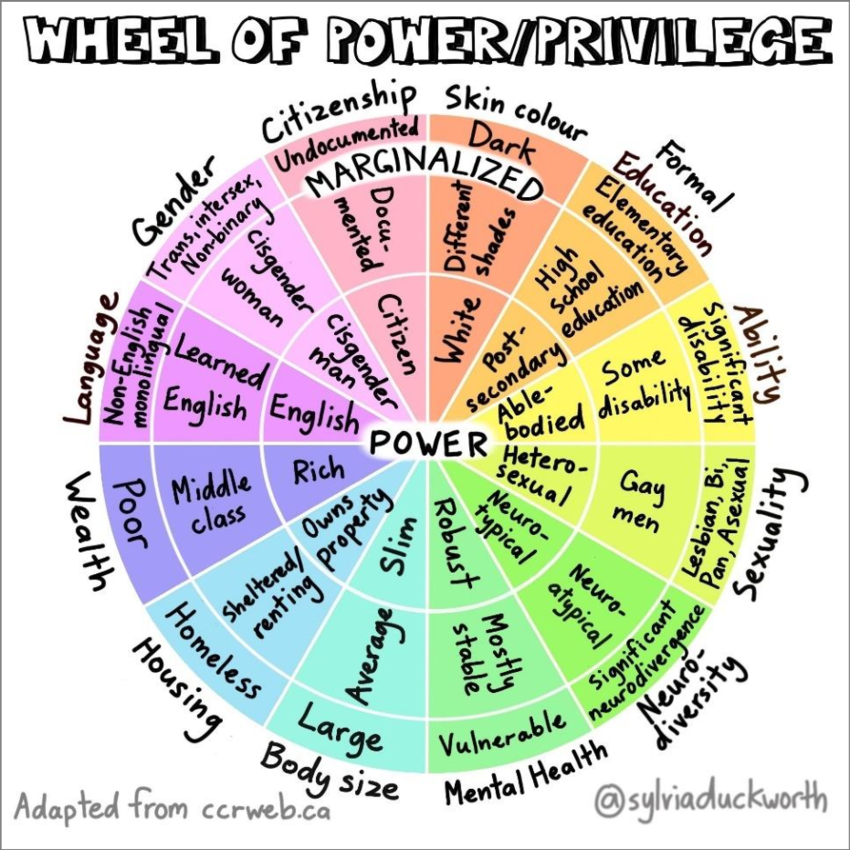
Wheel of Power/Privilege by Sylvia Duckworth
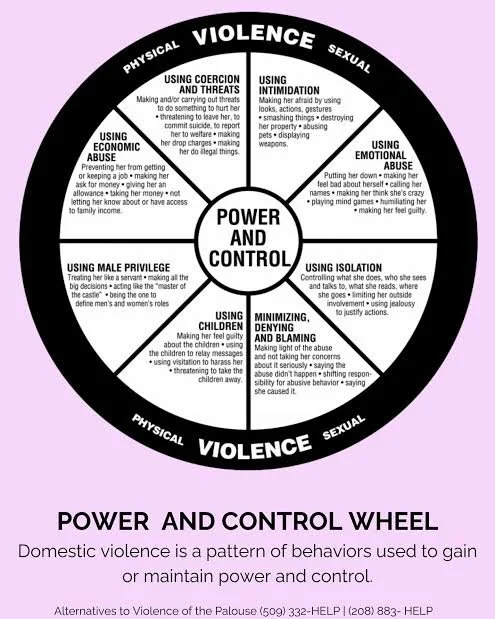
Because we exist at multiple intersections of power and privilege, multiple axes exist within interpersonal relationships where even multiply marginalized people in relationship can exert power-over dynamics. Coercive control, on the other hand, is an ongoing pattern of dominance behavior using a predictable set of tactics to exert power-over another person, enacted in cycles of harm followed by reconciliation.
Dr. Emma Katz is a criminology professor and nationally renowned researcher on coercive control. She writes that coercive control typically involves situations where the person doing harm subjects the survivor to persistent, wide-ranging, controlling behavior over a long period of time. The person doing harm demonstrates to the survivor that standing up for themselves against controlling behavior leads to punishment which may or may not include physical violence or other bodily harm. The long-term effects of psychological and emotional harm are no less damaging than physical violence. Coercive control in intimate partner relationships follows a predictable sequence:
Love bombing
Abusive behavior and minimization of harm
Power-over subjugation
Resistance of harm results in escalation
Survivor self-polices, “walking on eggshells”
Speaking out about harm leads to victim-blaming
Love bombing
In the early stage of a coercive control dynamic, people who engage in manipulative coercive control strategies begin by showering a partner with gifts, attention, validation, and affection. They rush to make long-term plans and commitments very early in a relationship, envision a future life together, making promises and grand declarations of love.
The objective of love bombing is not courtship, but rather the effect is to overwhelm and destabilize. The subject of lovebombing is flooded by neurotransmitters and hormones associated with intimate bonding, creating emotional attachment and feelings of intense pleasure. This experience of false intimacy is built not through demonstrations of consistency and trustworthiness, but fantasy. When abuse begins there can be tremendous confusion because the experience of harm is so incongruent with the lovebombing stage of the relationship, and the survivor yearns to return to those magical early days.
Survivors of coercive control in IPV dynamics may struggle to reconcile the harmful behavior, because the performance of “love” in the lovebombing stage is so convincing. However, as bell hooks wrote in her classic text All About Love, “Love and abuse cannot co-exist.” Healing from coercive control takes place when the survivor releases the lovebombing fantasies spun by the person who did harm, coming to terms with the fact that the relationship was built not on love but illusion.
Abusive behavior and minimization of harm
Lundy Bancroft is a counselor and investigator working for over thirty years with survivors and people who have done harm in intimate partner relationships. In his book Why Does He Do That? he explains that the person doing harm uses manipulative and controlling behavior, often justifying the harm to themselves through distorted thinking. He emphasizes that the “behavior is primarily conscious — [they] act deliberately rather than by accident or by losing control of [themselves] — but the underlying thinking that drives [their] behavior is largely not conscious.” (p.113) A lifetime of familial, societal, and cultural messaging has been integrated at such a deep level that these behaviors are largely automatic; the underlying motive is desire to control and a sense of entitlement.
Minimization serves both to justify the harmful behavior to oneself and gaslight the survivor, leading them to question their own perception of reality. Minimization can also involve blame-shifting (deny, attack, reverse victim and offender = DARVO) Minimization can sound like:
“I was only joking. My friends don’t care if I call them names.”
“I can’t believe you’re making such a big deal about this.”
“You’re overreacting, actually it is you who is the reactive one.”
Gaslighting
Gaslighting creates distortions of reality, sometimes built on partial truths so the victim-survivor becomes uncertain about what is actually true and begins to question their own judgment and perception. Coercive power-over and epistemic subjugation occurs when the dominant person’s version of reality is granted primacy in the relational field. Gaslighting can sound like:
“You misunderstood me. I am hurt that you would say I would do [the harmful thing they just did].”
“It’s really not that bad, is it?”
“Do the bad times really outweigh all the good times?”
“Would you really throw away everything we have just because of occasional conflict? Maybe it’s because you’re actually avoidant…”
The survivor experiences cognitive dissonance when the person doing harm says one thing but does another, leaving them to question the validity of their own experience and interpretation of reality. Over time, gaslighting creates confusion about whether the harm someone is experiencing is actually even happening. The survivor may ask themselves, “am I being too harsh or extreme in my position (of not tolerating harmful behavior)?”
The “[person that uses] coercive control regularly switch[es] between behaviors that seem positive (kind, caring, helpful, sweet, generous) and behaviors that are shockingly upsetting, scary, mean, selfish, callous and cruel.” (Katz, 2026)
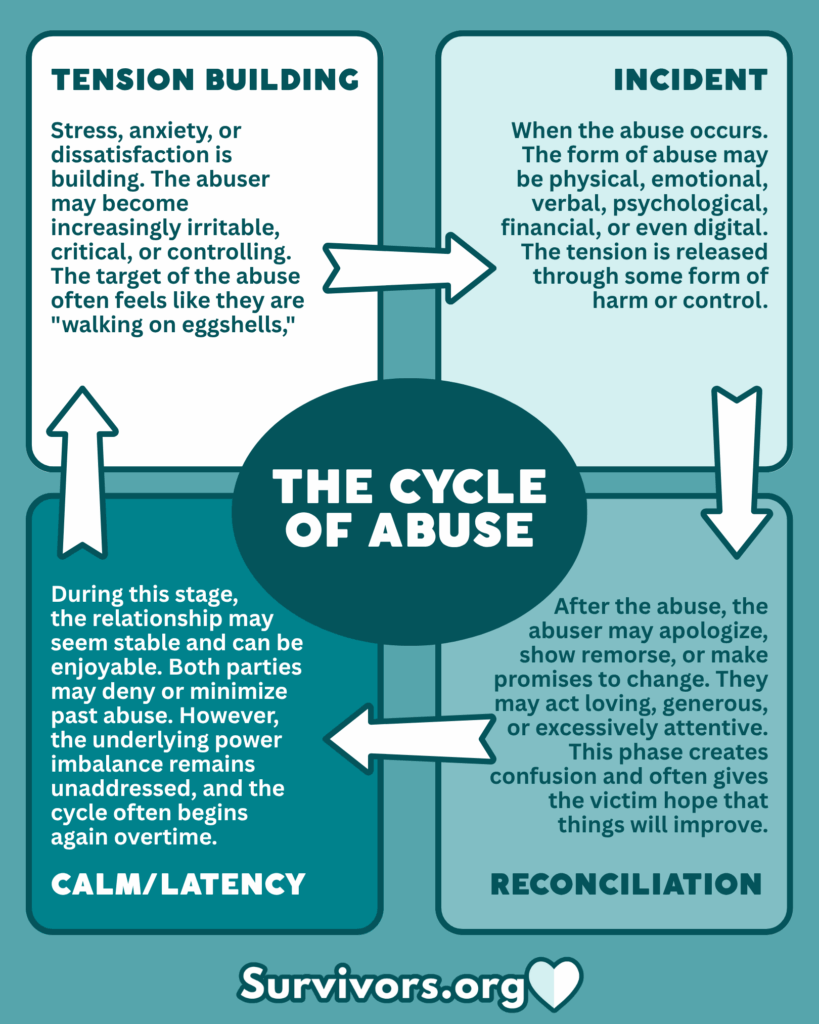
Along with minimization, people who use coercive control in interpersonal relationships swing between extremes of behavior, from abusive to seemingly positive and back again. These patterns begin to take the shape of a predictable cycle.
Weaponizing empathy
This switching between “positive” and negative behavior distorts reality for the victim-survivor in a really harmful way. In the survivor’s distorted reality it seems as though she has a “rocky relationship” or “marriage problems”. These are things that she has been taught by society are potentially fixable. So, naturally, she works on trying to fix them. (Katz, 2026)
People who use manipulation and coercive control in interpersonal relationships exploit the empathy and compassion of their counterparts, covertly and overtly. Empathic people see the good in others, believe that people can change, are willing to give grace, and are willing to give second (and third, fourth, etc) chances. In coercive control interpersonal dynamics, empathy is weaponized to subjugate survivors, manipulating through guilt any resistance to harmful behavior. People who do harm may also manipulate survivors by exploiting abolitionist values, weaponizing their oppressed identities or their risk of victimization by state or societal violence.
Exploiting the survivor’s empathy and belief in the potential for positive change keeps them hooked in the abusive dynamic. In the cycle of abuse, incidents of harmful behavior are followed by remorse, promises to change, reconciliation, and a brief return to the good times. Periods of latency and positive-seeming behavior fuel the survivor’s hope that their partner is truly committed to change.
But the hidden truth behind the distortion created by the [person doing harm] is that [their] periods of positive-seeming behavior are manipulative. [They] want to maintain the illusion that things are only bad some of the time and that there are good times too. This is crucial in [their] efforts to keep the [survivor] stuck in an abusive relationship with [them]. (Katz, 2026)
According to Bancroft, expressions of remorse may be experienced as sincere by the person doing harm, but in and of themselves they are meaningless to disrupt the pattern of coercive control. Significant and prolonged work is required to deconstruct the distortions of thinking that underpin coercive control strategies. He notes that the majority of cis-men who enact IPV do not make such deep and lasting changes even with access to high-quality treatment programs. (p.334)
A crucially important aspect of the cycle of abuse is intermittent reward. Intermittent reward is well-established in behaviorism as the most powerful inducer of biochemical reward pathways driving human behavior. Exploitation of the neurobiological reward system leads to physiological, behavioral, emotional, and psychological dependency. The reconciliation phase of the cycle corresponds with dopamine release (pleasure/reward), oxytocin (bonding), and norepinephrine (fear/excitement). This internal cocktail is profoundly addictive, and serves to reinforce the subjugated party’s attachment to the perpetrator of coercive control (colloquially referred to as “trauma bonding”). (Bhardwaj, 2026)
Escalation and self-policing
Through repetition of the abuse cycle of coercive control, survivors begin to self-police to avoid triggering their partner’s reaction. The pattern of subjugation is quite entrenched, reinforced repeatedly through activation of the survivor’s neurobiological arousal pathways, distorted thinking and cognitive dissonance, and addiction to the relief of reconciliation. The survivor begins to engage in fawning behavior, an adaptive survival strategy to the fear response. Escalation can lead to an increase in the frequency and/or severity of incidents of harm. Confronting the harmful behavior, resisting subjugation, and attempting to leave can be dangerous for victims of coercive control, as the person doing harm may respond with an escalation of punishment.
Victim-blaming
An insidious tactic of coercive control is to subtly or overtly damage a survivor’s reputation and credibility, preferably long before they speak out about the behavior of the person doing harm. Very stealthy manipulators will carefully engage plausible deniability in public so their behavior appears perfectly innocent to bystanders who are not privy to what occurs behind closed doors. They triangulate members of the community with smear campaigns to discredit the survivor. These efforts may take advantage of social dominance hierarchies and exploit the implicit biases of others.
“It does not seem believable that [the accused person] did this, they must be exaggerating…”
"I’ve only ever known them be kind and considerate, it can’t be true.”
“There are two sides to every story.”
People outside of the intimate partner dynamic who get triangulated by people using DARVO can compound harm to survivors when they don’t believe them, side with the person doing harm, or pressure the survivor to join them in rallying behind the potential of the person who did to change. In the aftermath of IPV, it is common for people who do harm to remain surrounded by community while the survivor is further isolated.
Accountability
Mia Mingus, Disability Justice and Transformative Justice activist, is quoted in Fumbling Towards Repair: A Workbook for Community Accountability Facilitators as saying, “True accountability is not only apologizing, understanding the impact your actions have caused on yourself and others, making amends or reparations to the harmed parties; but most importantly, true accountability is changing your behavior so that the harm, violence, abuse does not happen again.” (p.79) The steps in the pathway of accountability require first that the harm be stopped, acknowledgment of the harm and recognition of the consequences, and a demonstrable change of harmful attitudes and behaviors so that the harm does not recur. The work of changing the complex and often contradictory attitudes, beliefs, and biases underlying patterns of harm requires the ability to be honest and vulnerable with oneself and others. It requires pulling back the veil to see the rot below the surface, a descent into the underworld to confront the shadow of the psyche. Bancroft advises that the self-focus of people who do harm, combined with entitlement, lack of empathy, and the benefits they gain from controlling intimate partners, must be outweighed by the severity of consequences from their behavior in order to motivate change. (p.360)
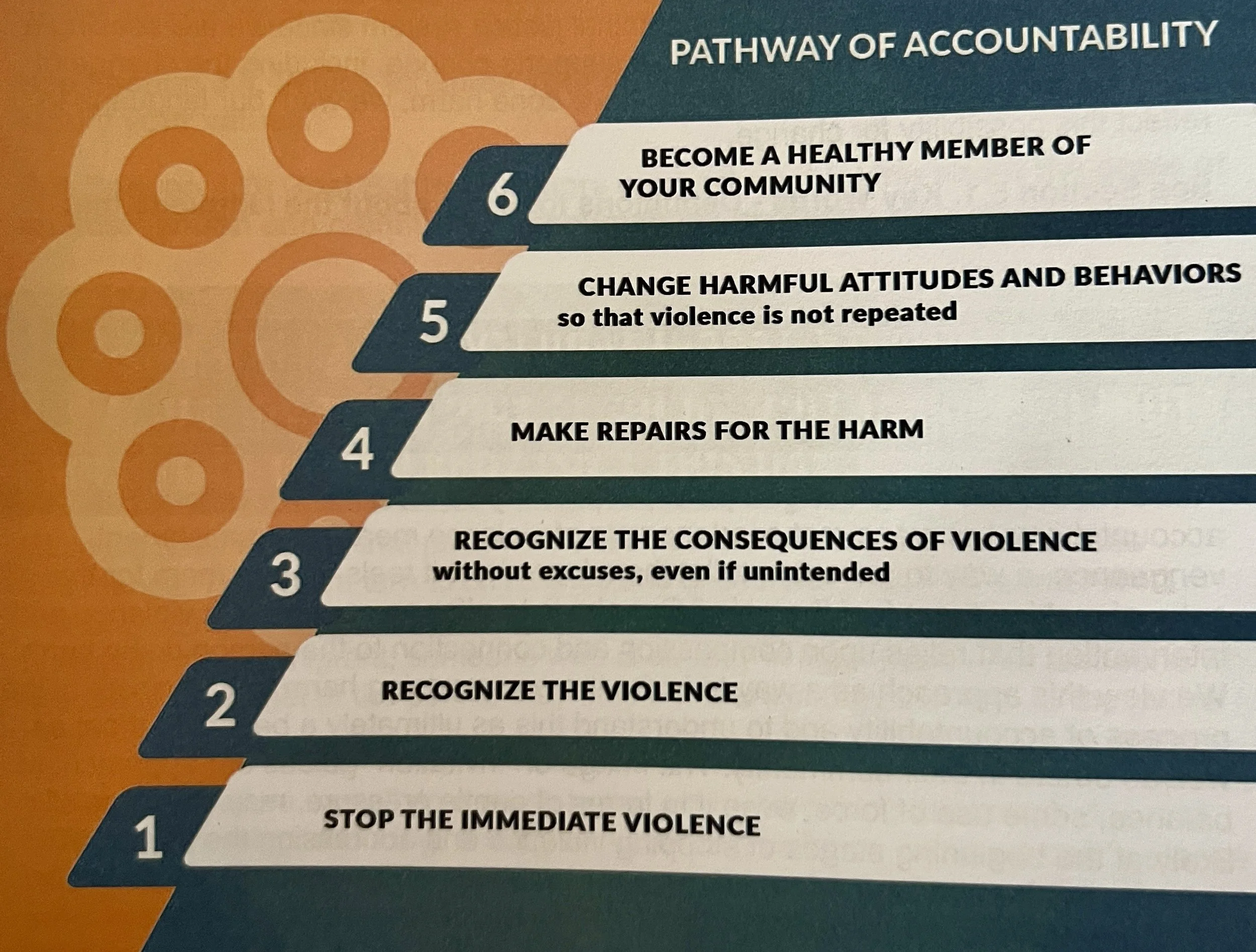
(Creative Interventions, 2012. p. 361)
Community accountability
We usually think of the person doing harm as the one to be accountable for violence. Community accountability also means that communities are accountable for sometimes ignoring, minimizing or even encouraging violence. (Creative Interventions, 2012. p32)
Rather than thinking about interpersonal harm as an individual problem, Transformative Justice approaches suggest we view it as a social problem requiring community accountability (CA). Such work is “driven by the belief that we can end sexual and gender-based violence.” (Kaba, 2019) Trauma-informed principles are essential, including safety for all participants, with choice and control in the hands of the survivor. CA processes require radical honesty, time, trust in the best intentions even of the person who has done harm unless they demonstrate a lack of integrity in the process, and a change in behavior with commitment to avoid the same harm in future. If these components are not present, community accountability processes may be unsuccessful or damaging.
Unskillful attempts at community accountability can cause further harm to survivors. Survivors may be put in the position of needing to sacrifice their safety and dignity to maintain social belonging, having first been isolated by intimate partner violence itself and further estranged after naming the harm. Not all communities or all members of a given community have the capacity for community accountability. Some communities or some community members may demonstrate “high conflict” characteristics, potentially indicating that there may not be capacity for the honest, open, and vulnerable communication required for CA processes.
Kai Cheng Thom, mediator and mental health community worker, recently published work exploring high conflict dynamics in Transformative Justice CA mediation. Citing mediator, lawyer, and therapist Bill Eddy who coined the term “high conflict,” she acknowledges critique of this concept while recognizing its usefulness to describe dynamics involving intense and unmanaged emotions, binary thinking, extreme behaviors, and a blame orientation. She writes, “In a high conflict dynamic, common conflict transformation strategies such as asking deep questions and inviting mutual vulnerability are often unsuccessful or even dangerous to attempt, because ‘high conflict,’ unlike normative conflict, does not include a shared capacity to practice trustworthy behaviors, develop self-insight, or hold multiple truths. Instead, high conflict often calls for stabilization, problem-solving and the practice of kind and healthy boundaries.” (Thom, 2026)
Healing from coercive control
For survivors of coercive control, it can take a great deal of time to rebuild eroded self-worth, relearn to trust one’s own judgment and perceptions of reality, and forgive oneself for any self-abandonment experienced while under the influence of a coercive control dynamic. There is never an obligation for survivors to extend forgiveness, offer repair to the person who did harm, or rally behind a belief in their potential to change.
Ascent from the underworld
Venus’ disappearance from view in its retrograde cycle is told in the myth of Inanna, descending to the underworld for forty days and nights. Just as Inanna ultimately rises from the underworld and makes her ascent, so too may survivors recovering from coercive control. May the strength of Inanna, Queen of Heaven and Earth, be with you.

Akkadian seal depicting Inanna, Source: Wikipedia
Bancroft, L. (2002). Why Does He Do That? Inside the Minds of Angry and Controlling Men. Penguin.
Bhardwaj, S., Ali, A., & Paul, F. A. (2026). From use to abuse: psychological, neurobiological, and spiritual pathways in relational harm and recovery. Frontiers in behavioral neuroscience, 20, 1805594. https://doi.org/10.3389/fnbeh.2026.1805594
Creative Interventions (2012) Creative Interventions Toolkit: A Practical Guide to Stop Interpersonal Violence. AK Press.
hooks, b. (1999). All About Love: New Visions. William Morrow.
Kaba, M & Hassan, S. (2019). Fumbling Towards Repair. Project NIA and Just Practice.
Katz, E. (5 July, 2026). Explaining coercive control to people who don’t quite get it. Decoding Coercive Control Substack. https://dremmakatz.substack.com/p/explaining-coercive-control-to-people-cef
Owens, R. (2020). Love and Rage: the Path of Liberation Through Anger. North Atlantic.
Stuart, G. (1 February 2019). 4 types of power: What are power over; power with; power to and power within? SustainingCommunity. https://sustainingcommunity.wordpress.com/2019/02/01/4-types-of-power/
Thom, KC. (9 September, 2026). Brief Thoughts on High Conflict in Social Movement Culture. instagram.com/p/DdFjV4KjZKq/?utm_source=ig_web_copy_link&stkn=MzRlODBiNWFlZA==